How lovely it would’ve been to have lived in the real world! To enjoy things fully the way some people seem to. Family. Football. Days out. Art. I wouldn’t have had to look on at life as if from behind a window, with this weird, vast space always in the back of my head. I wouldn’t have had to think about being in the moment as if it were foreign to me. I imagine I’d have had a career, a wife and kids, a car, and coped easily with the same routines day after day. I see how other men go about it, watch them almost with the eyes of a child, learn from them cagily, but sometimes in my arrogance they seem like one big illusion, the enterprises of men – something really decayed, removed from what’s essential in life.
Kafka loved an anecdote about Flaubert in which the latter sees a family on a fun day out and remarks: Ils sont dans le vrai. But is it that simple?
We’re all of us masters at hiding from the truth, it’s deep in our nature. We hide from ourselves, from each other and from God. Things themselves seem to hide from us – that seems to be their nature too. They emerge and pass out of sight, appear and pass away, like animals in the forest. Real life, says Heidegger, happens when beings become ‘unhidden’, when we help bring things out of their hiding places and step out of our own along with them, into the light of being itself. It happens in rare moments when we see links between ‘beings themselves, the human world, the work of God.’ It can only occur, he says, when you’re disturbed by a sense that real life is elsewhere.
But real life is slipping away, isn’t it? You can almost feel it — soon it’ll be almost nowhere to be found. We’ll have covered the world with ourselves and taught our own technologies to think for us, to hide us for good.
Posted onMarch 5, 2023|Comments Off on A place like home
Settled now. Back in Norwich, in a rougher part of town. I chat to the locals and the immigrants. The Kurds in the shops, the Indians in the corner shops and curry houses, the old boys and the Spanish waitress in the Duke of Wellington. Apart from the usual hooded English lads trying to look scary, people are friendly and talkative. At last I can speak. They still don’t seem to mind that I’m foreign, as long as I get the tone; and I’ve been starved for talk.
They tell me crime gossip. The boarded-up house next door to mine was a grow house. The shop beside that, also boarded up, was owned by a man who kept a teenage girl locked up. The Tamils running the corner shop were robbed by Eastern Europeans. A drunk woman drove down the road with a missing tyre, bumping into all the parked cars. The nail bar and Turkish barber are laundering fronts. The burger bar round the corner doesn’t sell burgers: Albanians walk in and out. They’re no fools, the locals, they know what goes on, they just have little way of changing it.
And I’m back in the best pub in the world, the White Lion. Where we still remember each other’s names and stories, and can catch up: a place like home.
Posted onMarch 5, 2023|Comments Off on The Art of Detachment
L’esercizio del distacco: a novel by Mary B. Tolusso, which hasn’t been translated into English. A masterpiece. My translation of the first page of the Danish translation:
Everyone has experienced moments of absolute happiness that they shouldn’t have survived.
When my mother left me in front of the gate to the boarding school, I was fourteen. Before she started the car again, she caressed my hair. It’s blonde, and too long: ‘You should get a haircut’, she said. I’d like to have cut her hands off and taken them with me. I didn’t go inside straight away; before I rang the doorbell, I tried to remove some chewing gum from the pavement. I toed it loose with my shoe while looking down so as not to see her car disappear into the traffic.
In the big foyer there are photographs of former pupils and a portrait of a young Italian hero, and across from them large windows looking onto the garden, a green peninsula where we spent our spare time. When we walked in the park we often fantasised about our own fatal endings, sometimes heroic.
At the boarding school you couldn’t avoid going for walks. The teachers didn’t like the pupils being together in their rooms. Emma, David and I often walked together. We loved going down the path lined by holm oaks, which each year were mutilated so they could never reach each other and form a shady passage. We never associated our path with words like ‘luxuriant’, and it was impossible for anything furtive to happen there. A triumph of amputated branches and trunks. We called it the Platz. ‘It’s not a path, it’s a Platz’, said David with his crooked smile. He had chalk-white teeth. The maimed branches couldn’t conceal us. Of course, this was an architectural requirement designed to make it easier to control, as in any other prison.
For boarding school students, there’s not much to strive for: either you keep living or not, either you improve yourselves or you’re defeated.
Posted onMarch 1, 2023|Comments Off on Review of The Moment
My translation of Jakob Kvist’s review of the Danish version of The Moment (Øjeblikket).
A powerful debut novel about approaching life’s mystery
The Moment is an original, thought-provoking and beautiful book by Peter Holm Jensen, a Dane who has lived abroad for most of his life, mainly in Britain. It was originally written in English and has been skillfully translated into Danish by Alexander Carnera with an intimate understanding of the book’s core concerns.
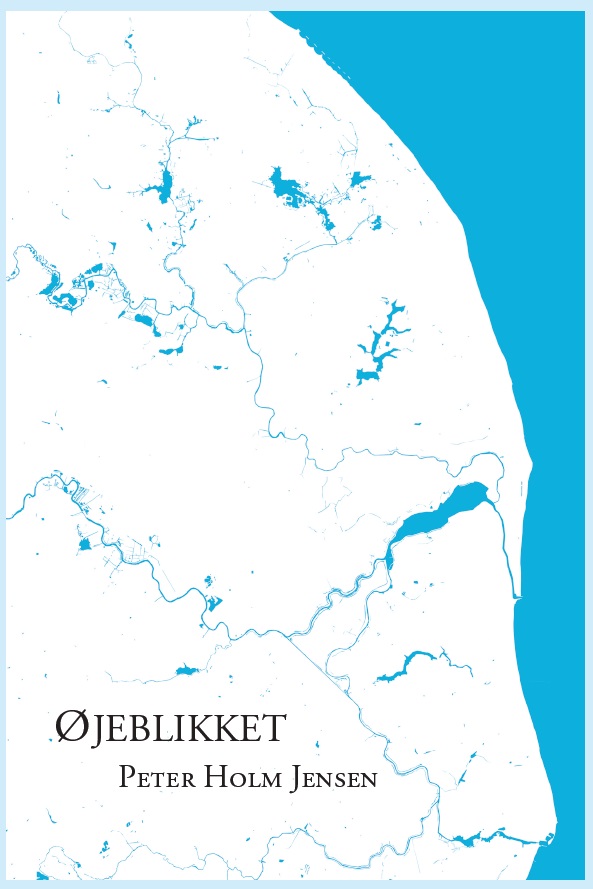
Øjeblikket Det Poetiske Bureaus Forlag, Copenhagen, 2022
By Jakob Kvist
Let me make it clear from the start: this is an unusual book. The Danish publisher calls it a novel in journal form. In diarylike entries, we follow the main character’s life in the Norfolk countryside, where he’s recently moved with his girlfriend, his meagre career as a freelance translator, his friendship with his neighbour, nature walks, pub visits, and wider thoughts about the relationship between thinking and acting in the world. The nature of time is a recurring question. The book examines lived everyday life through various theological, scientific and philosophical lenses. Existential questions are brought to light in a modest yet confident tone. Sensory descriptions of the author’s surroundings are complemented by quotations from, and reflections on, various thinkers such as Heidegger, Rilke, Mark Fisher and Kafka.
Everyday presence
The book closes in on things that are often buried under day-to-day life. What tends to remain unspoken is spoken here, in simple language. For example, a writing block is described as a moral defeat. One senses a forlornness, but it’s a forlornness that seems to be overcome by the way it’s presented in the journal.
Everyday life isn’t subjected to symbolic, psychological or self-help interpretations. What’s given most attention is what’s right in front of us, and so easily overlooked. By slowing down thought and focusing on the present, the book reminds us that we’re always in nature, and that in some sense it calls to us. The difficulty of realising this is hinted at in a very different passage from earlier in the narrator’s life that describes ‘a haze that began to gather between me and the world.’
As a freelance translator, the narrator thinks about the situation he’s found himself in: always looking at screens, waiting for jobs to pop up before they’re snapped up by other translators, and how this exploitative scenario has arisen and become accepted in the holy name of competition.
The moment
This book circles around ‘the moment’ as a different experience of time. An experience that’s foreign to us because it’s not born of haste and stress. When we’re busy, we do what we’ve got to do with blinders on. We’re absent, don’t sense the deep time that is the time of life, life-giving time.
By slowing things down and writing about what we often brush aside in daily life, you could say the journal is an example of what it preaches. By drawing back from contemporary working life’s invasion of time, the book enacts a particular way of being in the world. It says: by refusing to be distracted by the myriad forms of entertainment on offer today and managing to dwell where you already are, in this body, you can approach a different experience of time. A place where time almost stands still. This may sound abstract, but really it’s quite down to earth.
It seems to be a question of opening your eyes up to where you already are, where our surroundings seem to speak to us with a renewed presence. ‘It’s moments like these I want to write about. Moments when you’re stopped on your way and made to see where you are with new eyes. As when you work on a problem that seems unsolvable and all of a sudden the answer comes: it was there all along, why couldn’t I see it?’ One way to approach the world is through questioning it, even if ‘words flow through you in an unceasing stream.’
A sculpture made of scrap metal by a local artist is described as ‘so elaborate I have to walk around it for a while to take it in.’ It’s when we allow ourselves to be amazed by the things around us that we can begin to face the world openly. The things that are closest to us become ‘visible’, and the weirdness of their being takes centre stage. It’s easier said than done: ‘Sometimes the nearest things are the hardest to see’, because when we get used to them they lose ‘all mystery, all presence’.
Balancing between the personal and the impersonal
This book is a fine description of how one can use the stuff of personal experience to reach for what Jensen calls ‘the impersonal’. You yourself are the starting point, but the aim is to get beyond yourself to the light of being itself. By dwelling on the commonplace, we might allow it to show sides of itself that are usually hidden to us: ‘Doesn’t being lurk most mysteriously – nearest and furthest – among the things we move around every day, in the fact of their being here at all?’ But we don’t see the secrets of the everyday because ‘perhaps only our impatience obscures them.’
The narrator also asks: ‘Is there a way to seek the truth and be in the world at once?’ Does it make any sense to talk about truth in an atomised, individualist age of fake news? Is there a vantage point for observing the truth, or is everything just a construct?
Perhaps the truth consists in an ability to undergo the things that happen to you. The truth might emerge when we turn language inside out and let truth do its work on us: ‘Not pursuing it like a goal but trusting it without second-guessing, and going humbly about your life.’
Another line from the book: ‘Writing is a house of being under construction; sometimes you feel you’re living in rubble.’ Masterful way to bring Heidegger’s thought down to earth. When we live truly, we’re turned towards life. To sum up one of the book’s many insightful reflections, we might be the only species that can truly experience time, and this may be our chance to reconnect with the planet we inhabit. Maybe the ‘moment’ happens when we wake up to where we already are. A daily repetition that ‘makes the same new and lets you face the future, lets you function in the world.’
The Moment is a powerful book that shifts our habitual way of thinking towards a wider worldview. It’s a healthy alternative to the kind of self-help literature you see everywhere nowadays. You might even risk getting wiser about life by reading it. It’s simple, sure in its style and arguments, and open to the world. It finds a language for the enigmas of ordinary life that we so easily pass over.
This book reminds us that life takes place here and now, not in some abstract future. The moment, it says, is a different experience of time and an experience of another time. Or in the narrator’s words: ‘The moment lurks inside everyday time. It waits to give you back your life, like an event long prepared without your knowledge, like an act of fate. It needs you: your ragged past, your timid present, your whirl of thoughts, your hoard of words. It waits for you to step into the light of day, where it can find you and let you come into your own.’
Posted onMarch 1, 2023|Comments Off on Kafka’s second aphorism
Alle menschlichen Fehler sind Ungeduld, ein vorzeitiges Abbrechen des Methodischen, ein scheinbares Einpfählen der scheinbaren Sache.
All human errors are impatience, the premature breaking off of what is methodical, an apparent fencing in of the apparent thing. (tr. Kaiser/Wilkins)
All human errors stem from impatience, a premature breaking off of a methodical approach, an ostensible pinning down of an ostensible object. (tr. Hofmann)
Impatience is the only cause of human error. This means no human error cannot ultimately be traced back to anything but impatience. Impatience is a topic Kafka returns to throughout the aphorisms.
Why be impatient? It suggests the desire to be done and to move on is greater than the desire for the correct result; and that, as a method becomes more thorough, and therefore presumably more accurate, it becomes correspondingly more exasperating to use.
Method is designed to exhaust the possibilities, to miss nothing; taking absolutely everything into account is the key to reasonable planning and understanding, and at the same time it’s a maddening exercise in frustration. You begin to realize people don’t use words like “exhaust” just by chance when they talk about this.
But then, doesn’t the thinker care at all about the result? He must, and yet he seems too content to plod methodically on — unless of course he really only loves the method, and is disinclined to set much stock in results.
Ostensible objects — they may be illusory or they may be able to be constituted in a variety of ways: the flower and the bee may be two objects from one point of view and only one object from another. It isn’t just a matter of labelling an object, but of distinguishing the boundaries of each object.
Kafka seems preoccupied with methodical procedures, especially with all the ways they can go wrong, but nothing ends. The error isn’t an end nor does it finish anything, but it marks the point in the development of a line of inquiry beyond which nothing useful can be expected.
The method defines what constitutes an error, but in general, error is abandoning method (usually without noticing, like falling off the rope in Number One). But how well does the method do when it comes to providing a satisfactory notion of success? The method is designed to identify and avoid error, and it may be that it can only define success in terms of scarcity of error; that minimization of error (accuracy) is equivalent to truth is taken for granted.
Error is breaking off method prematurely, but how do you know when to break off method maturely?
Error arises when one breaks off method prematurely, because this leads to an inessential understanding based on mere appearances. One settles for what seems to be true, and then reasons from that appearance. Kafka’s fiction is replete with examples of this.
From this, we may infer that truth, for Kafka, is less a result and more a way of remaining true, by patient application of method.
For skandinaviske laesere, en anmeldelse af min bog, af Jakob Kvist:
Øjeblikket
Bogen kredser om øjeblikket som en anderledes erfaring af tiden. Her ikke blot tale om en anden erfaring af tiden men erfaringen af en anden tid. Den er en erfaring af tiden, som er fremmed for os, fordi den ikke trives i stress og jag. Når vi har travlt, suser vi derudaf med skyklapper på. Vi er fraværende og registrerer dermed ikke den langsomme, dvælende og frie tid. Den tid, som er livets tid.
Ved at sænke tempoet og skrive om det, vi overser i hverdagen, kan man sige, at dagbogen praktiserer, hvad den prædikener. Ved at trække sig tilbage fra arbejdets invadering af tiden praktiseres en særlig måde at være i verden på. Når man ikke lader sig forstyrre af samtidens mange underholdningstilbud, men netop formår at dvæle dér, hvor man allerede er, forankret i en konkret krop, bevæger man sig mod erfaringen af en anden tid. Her hvor tiden står stille. Det lyder måske abstrakt, men er uhyre praktisk.
Det handler om at slå øjnene op dér, hvor man allerede er. Det er her, hvor omgivelserne henvender sig til os i et forstærket nærvær: ”Det er øjeblikke som disse, jeg gerne vil skrive om. De stunder, hvor du stopper op på din vej, og som får dig til at se, hvor du er, med nye øjne. Som når du arbejder på et problem, der virker uløseligt, og ud af det blå kommer svaret. Det var der hele tiden; hvorfor kunne jeg ikke se det?”
Med sproget henvender vi os til naturen, fordi: ”Ord flyder gennem dig i en uophørlig strøm”. Det er ved at spørge, at vi nærmer os verden. En skrotskulptur beskrives i dagbogen som: ”… så detaljeret, at jeg er nødt til at gå omkring det i et stykke tid for at kunne tage det til mig.”. Det er, når vi lader os forbløffe af tingene i vores omgivelser, at vi gør verden åbent i møde. Det, som er nærmest, bliver synligt og tilværelsens gådefuldhed kommer i centrum. Det er lettere sagt end gjort: ”Nogle gange er de nærmeste ting de sværeste at få øje på”, fordi når vi har vænnet os til dem, så mister de ”al deres gådefuldhed”.
At balancere mellem det personlige og upersonlige
Bogen er en fin beskrivelse af, hvordan man kan bruge det personlige til at nå frem til det upersonlige.b Man er selv udgangspunktet, men formålet er at overskride sig selv for at nå frem til værens lys. Ved at dvæle ved det almindelige, giver vi det almindelige mulighed for at vise anderledes sider af sig selv og dermed erfare, hvordan: ”Ligger væren ikke på lur på gådefuld vis – nærmest og fjernest – blandt de ting, vi bevæger os omkring i det daglige?”. Men vi ser ikke dagligdagens hemmeligheder: ”Måske er det kun vores egen utålmodighed, der skjuler dem”.
”Er der en måde at søge sandheden på og samtidigt være i verden?” reflekteres der over i bogen. For giver det mening at snakke om sandhed i en relativistisk tid præget af fake news og individualisering? Findes en ophøjet position for iagttagelse af sandheden eller er alt blot en konstruktion?
Måske sandheden består i evnen til at nedlægge sig i de begivenheder, som sker med én. Sandheden viser sig måske, når vi vender sproget på vrangen og åbner op for: ”Ikke forfølge det som et mål, men stole på det uden at spille bagklog, og bevæge sig ydmygt gennem livet.”.
Andetsteds hedder det: ”Skrivning er et værens hus under opførelse; af og til føler man, at man bor i en bunke murbrokker”. Mesterlig måde at hive Martin Heidegger ned på jorden. Når vi lever sandt, vendes vores eksistens mod livet. Vi er måske den eneste art, som kan opleve tiden på en dybere måde og det er måske vores mulighed for at forbinde os med planeten igen – sådan lyder en af bogens mange flotte refleksioner. Måske er øjeblikket der, hvor vi forbinder os til verden ved at vågne op der, hvor vi allerede er. Øjeblikket er en daglig gentagelse, som: ”gør det ensformige nyt og lader dig gå fremtiden i møde, lader dig begå dig i verden.”.
”Øjeblikket” er en stærk bog, som bevæger vores verdensbillede mod en større mening. Bogen er et sundt alternativ til den allestedsnærværende selvhjælpslitteratur. Man kan faktisk risikere at blive klogere på livet ved at læse Peter Holm Jensens dagbogsroman. Bogen er enkel, stilsikker, velovervejet og åben overfor verden. Med bogen er der skabt et sprog for hverdagens gådefuldhed, som vi så nemt overser.
Med bogen i hånden bliver vi mindet om, at livet foregår netop nu i dette øjeblik og ikke i en abstrakt fremtid. Øjeblikket er en anden erfaring af tiden og erfaringen af en anden tid. Eller med forfatterens skarpe pen: ”Øjeblikket ligger på lur inden i hverdagens tid; altid nyt, altid det samme. Det venter på at give dig dit liv tilbage, som en længe forberedt begivenhed, du ikke har været vidende om, som en skæbnehandling. Det behøver dig: din lasede fortid, din beklemte nutid, din hvirvlen af tanker, dit forråd af ord. Det venter på, at du tager næste skridt ind i dagens lys, hvor det kan finde dig og lade komme til dig selv.”
Is it perhaps because we live in a philosophical age that cannot bear broaching metaphysical or ontological issues and questions? Is it perhaps because we live in an age that cannot bear that there may be more than human being and the “world” that we construct? Is it perhaps because we live in an age that cannot bear the thought that there may be an ultimate underlying unifying unity to all things that beckons us to listen in awed silence and that is the Source of joy for us beyond every heartache? These are important questions for us in the present age, and I suggest that we need to be more attentive to them.
Everyone carries a room about inside him. This fact can even be proved by means of the sense of hearing. If someone walks fast and one pricks up one's ears and listens, say in the night, when everything round about is quiet, one hears, for instance, the rattling of a mirror not quite firmly fastened to the wall.

 Notes from a Room
