
Category Archives: Writing

Splice’s description of The Moment:

In the murky aftermath of a breakdown, a man still at odds with himself takes flight to a cottage in rural Norfolk. There he intends to strip his life of everything trivial, everything superfluous, paring it all back to the essential truths, values, and experiences. In doing so, he keeps a fragmentary journal: not a record of progress as such, but sporadic notes on his new surroundings as he attends to minor changes in search of an ideal moment-a moment of unity between body and mind, in which there is no distinction between sensation and thought. For decades he has been hounded by the sense of a split self, as if under observation by a nameless double, and he feels that the opportune moment, if it can be found, will relieve him, just briefly, of this spectral presence.

Peter Holm Jensen’s début novel is a mercurial marvel of contemplative literature that at once adopts and dismantles the diarist’s form of expression. It is not a linear account of ordinary events, but a cyclical and recursive record of noticing the ways of the world. It does not tell the story of its narrator’s life, but opens up for him a quiet space in which to savour the changes of the seasons, the migration habits of birds, his connectedness to his partner, the fluctuations of his ineptitude and capabilities. But it is also not an environmentalist’s lyrical notebook, for its author feels the pains of precarity and indignity under neoliberalism, nor is it an account of stoic persistence in the face of daily adversity and aimlessness. It is, rather, an attempt to come to terms with the indifference of the forces within which we live — time, nature, globalisation — and to extract from this void of meaning something immanent, something true.
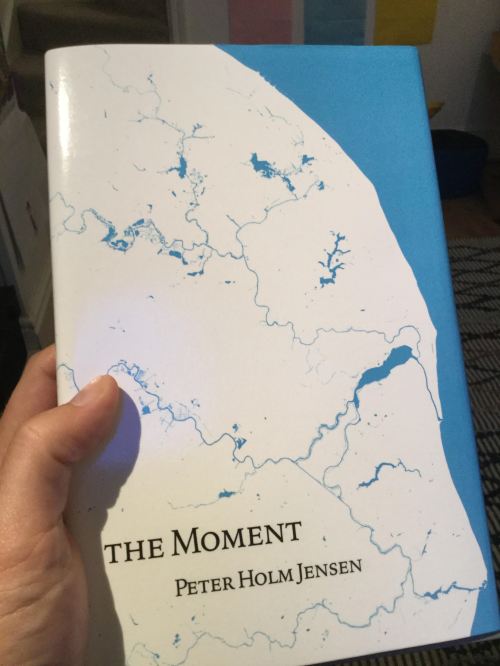
The Moment

In the murky aftermath of a breakdown, a man still at odds with himself takes flight to a cottage in rural Norfolk. There he intends to strip his life of everything trivial, everything superfluous, paring it all back to the essential truths, values, and experiences. In doing so, he keeps a fragmentary journal: not a record of progress as such, but sporadic notes on his new surroundings as he attends to minor changes in search of an ideal moment — a moment of unity between body and mind, in which there is no distinction between sensation and thought. For decades he has been hounded by the sense of a split self, as if under observation by a nameless double, and he feels that the opportune moment, if it can be found, will relieve him, just briefly, of this spectral presence.

The Moment

How to speak? How to tear apart the skin of words?

Czeslaw Milosz

The Moment

Photos of my forthcoming book, published by Splice.

The Moment 1

The Moment 2

The Moment 3

The Moment back cover

But a time would come when the book would be written, would be behind me, and I think that a little of its light would fall over my past. Then, through it, I might be able to recall my life without repugnance.

Sartre

The only genres I saw value in, which still conferred meaning, were diaries and essays, the types of literature that did not deal with narrative, but just consisted of a voice, the voice of someone’s own personality, a life, a face, a gaze you could meet.

Knausgaard

When I hear modern people complain of being lonely then I know what has happened. They have lost the cosmos. – It is nothing human and personal that we are short of.

D.H. Lawrence

More and more, fundamental life and death decisions are being made by machines, by software, without human intervention … And behind these machines, far behind them, opaque monoliths of capital, vast and cold and unsympathetic.

Will Wiles, via here

Physical work

Physical work is a specific contact with the beauty of the world, and can even be, in its best moments, a contact so full that no equivalent can be found elsewhere. The artist, the scholar, the philosopher, the contemplative should really admire the world and pierce through the film of unreality that veils it and makes of it, for nearly all men at nearly every moment of their lives, a dream or stage set. They ought to do this but more often than not they cannot manage it. He who is aching in every limb, worn out by the effort of a day of work, that is to say a day when he has been subject to matter, bears the reality of the universe in his flesh like a thorn. The difficulty for him is to look and to love. If he succeeds, he loves the Real.

That is the immense privilege God has reserved for his poor. But they scarcely ever know it. No one tells them. Excessive fatigue, harassing money worries, and the lack of true culture prevent them from noticing it. A slight change in these conditions would be enough to open the door to a treasure. It is heart-rending to see how easy it would be in many cases for men to procure a treasure for their fellows and how they allow centuries to pass without taking the trouble to do so.

At the time when there was a people’s civilisation, of which we are today collecting the crumbs as museum pieces under the name of folklore, the people doubtless had access to the treasure. Mythology too, which is very closely related to folklore, testifies to it, if we can decipher the poetry it contains.

– Simone Weil, ‘Forms of the Implicit Love of God’ (tr. Craufurd)

A statement of a general nature

Man does not make a statement of a general nature without betraying himself completely, without unintentionally putting his whole ego into it, without presenting the basic theme and original problem of his life somewhere in the parable.

– Thomas Mann (via)