


For what was perhaps the first time, the journalist caught a clear glimpse of his inner self, pale and dazed, before it disappeared again, like a dream in the light of morning… It was not so much Cenabre’s words, with their vague suggestion of anger and scorn, as the complete change in the subtle priest and the way in which he communicated a compelling inner vision shown by an attitude and voice that dragged Pernichon’s inner core into the open like a muscle suddenly jumping out of its covering in a surgeon’s hands. Being seen as a skillful and ambitious man who weighed his chances, a doubtful friend and a watchful enemy, would not have offended him. The attacks he had just suffered, however, hit a deeper, more secret and sensitive spot, the point of balance, as it were, of his humble existence: the idea, which was now a habitual and integral part of his thinking, of an inner struggle, the need to be able to classify himself, a certain stability. His self-concept had been brutally uprooted, and the suddenly persuasive hypothesis of a life with no spiritual reality breaking into his normally very carefully managed conscience had been enough to shock him into seeing how totally chaotic that conscience really was. There are very many other people who watch more or less strictly over their actions and yet, like sailors observing the stars without looking at their compasses, are unaware of where their will or their perverted instincts are taking them. The horror lies not in the strangers whose paths cross ours but in the features our devastated soul will suddenly meet and not recognize as its own.
— Georges Bernanos, The Impostor (tr. Whitehouse)
Comments Off on Totally chaotic
Posted in Bernanos
Illness is the dark side of our transactions with nature. It’s a reminder of the routineness of death, of the disposability of individuals, of the fact that living systems can be ruthless and unpredictable in their constant manoevring. But, at first sight, depression doesn’t fit into even this austere picture. There’s no random physical ‘accident’ behind it and nothing which benefits, no opportunist virus or evolutionary climber. It seems to have no connection with the biological business of living at all. And what it did to me was unearthly, in that it negated, cut dead, all the things in which I most believed: the importance of sensual engagement with the world, the link between feeling and intelligence, the inseparability of nature and culture. And it began to grow at the most unexpected time, when by all conventional psychological theories, I should have been awash with the sense of well-being that comes from high status and achievement.
— Richard Mabey, Nature Cure
Comments Off on Unearthly
Posted in Richard Mabey
But as soon as a man comes along who brings a primitivity with him, so that he does not say that one takes the world as it is (the sign of passing through freely like a stickleback) but says: Whatever the world may be, I relate to an original principle which I do not intend to change at the world’s discretion — the moment this word is heard, a transformation takes place in the whole of life. Just as in the fairy tale when the word is spoken and the castle which has been under a spell for a hundred years opens up and everything comes alive, just so life becomes sheer awareness. Angels get busy, watch curiously to see what will come of it, for this interests them. On the other hand, the sombre, grumbling demons, proper limbs of the devil, who for a long time have been sitting inactive and chewing their fingernails, leap to their feet for here is something to do, they say, and they have waited a long time for that.
— Kierkegaard, diary entry, tr. Hong and Hong, via here
Comments Off on Here is something to do
Posted in Kierkegaard
For Knausgaard, it is […] between the proximity and fullness of our “presence in the moment” and the remoteness of the feeling of “being outside something and considering it while being removed from it” that we find the place of art.
— Daniel Fraser, via here
Comments Off on
Posted in Knausgaard
I am unable to think, in my thinking I constantly come up against borders; certain isolated matters I can grasp in a flash, but I am quite incapable of coherent, consecutive thinking.
— Kafka, from a letter to Brod
Comments Off on
Posted in Writing
Kafka on Kierkegaard’s books: ‘They are not unambiguous and even when later he develops himself into a kind of unambiguousness, this is also just part of his chaos of spirit, mourning, and faith.’
Comments Off on
Posted in Kafka, Kierkegaard

Comments Off on
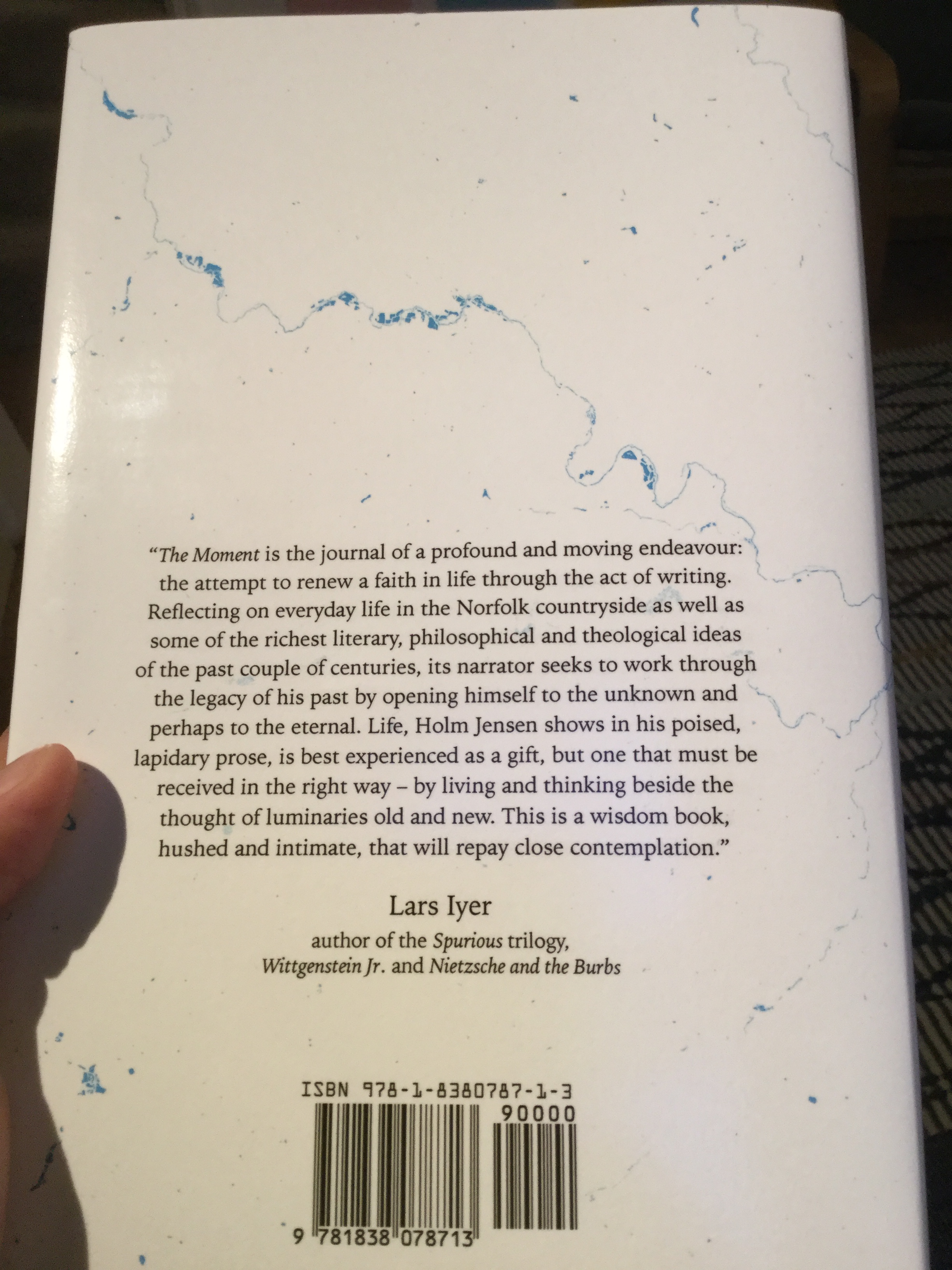
Flowerville on The Moment:
peter holm jensen – the moment (splice)
you had been meaning to write about this book since you finished reading it and you didn’t know how. this is a book in which we accompany the author through a couple of years living in rural norfolk; his ideas on writing, reflections on kafka and rilke; his partner; his neighbour who is a farmer who later on dies, the farm being sold, what this means when old farms are being sold; then there are his friends, some struggling to make ends meet; there are trips to surrounding villages; trips to the pub; his life as freelance translator and how this is brutalized by nasty old capitalism. alienation. misfortunes. grace. life going on, seasons. animals. vegetables. it is a kind of journal although it doesn’t feel this way.
you thought about it all and you thought it is very much a book about after, say, after something happened and somehow this had led to life being reduced to the essentials. not as a form of impoverishment, but as in all pretentiousness is gone, things are as they are, life is as it is, what is the nature of writing and what can be said, about everything. after all has been said and done. perhaps, as in: what if there’s nothing between you and the world anymore.
it’s really the stage after irony, after deconstruction and so on.
A power that made everything you are both meaningless and meaningful. Room to breathe, a sense of dignity. As long as you were shielded by time, held in the perfect stillness of the moment. How carefully it has to be approached. But maybe that’s not the right word. Questioned, perhaps. Or undergone.
it’s a book one can’t argue with. not that you would want that.
it’s been one of the most beautiful things you’ve read in a long time.
and it seems to you that this non-shallow beauty of this book lies in the acceptance of existence, of its difficulties and trials and also of the complicated and not always forthcoming beauty (but nevertheless existing) of life. it’s about holding on to that thread of being, a book of maturity and the occasional overcoming of alienation.
What seems clear to me now is that something goes wrong for everyone. One way or another, suddenly or slowly, of our own will or by force, we go astray. We lose sight of some essential part of ourselves; hide from being. But we can never close ourselves off from it completely, never lose our link to the unity we spring from. How could we? Michael Haar writes: ‘We are held in being, and no matter how tenuous the thread attaching us to presence – for example in fainting or dreamless sleep – we are never, as long as we are, released into pure nothingness.’ Never released from the link to being that lets us become our more or less divided selves and live on the same ground as all other beings, no matter how different from us.
Comments Off on Shielded by time
Posted in Flowerville, The Moment
“The time has come for us to be able to write and send messages within our mind,” as a friend tells Renouard. But the future may be even more efficient than that. “We will do a Google search exactly as we go looking through our memories, by a simple act of the mind which, like memory, will require neither the hand nor the eye as intermediary,” he writes. “We will use this inner Google to look up words and phrases in a foreign language,” he writes. “The memory of which our brain is the organ will no longer be an individual memory.” Renouard’s vision of the internet is one that is capable of doing a lot of our feeling and knowledge-gathering for us, and it’s persuasive because we can all cite examples where we’ve felt that happen, from auto-completes to self-driving cars.
*
The internet is a canny repository of many false sensations. Friends aren’t friends, followers don’t follow, links are digressions not connections, truth is a partisan cudgel in the hands of countless memelords. […] The internet, he writes, has turned knowledge inside out: Books, once our chief repository of wisdom, are now walled-off and inaccessible, “a distant and secret refuge protected from the curiosity of readers.” Information gives us more things to contemplate but hardly lets us think about them: “The last fortress of our involuntary memory will have been conquered by the recollection machine.” The internet will wreck our privacy, but our morality will simply adapt to it. The internet never forgets, but we’re now free not to think.
*
At one point Renouard himself sounds a skeptical note about all this. He asks, “What is there of a person in his traces, even if we reach a totality, a saturation, in the Great Downloading?” The internet tempts us into thinking it’s everything because it gives so much. It confounds our senses because it mimics them so well; it conflates truth and fact by making both seem porous. And it demands we still live with it. We’ll need tools to better navigate this, and one more irony about the internet is that that the internet is unlikely to provide such tools. To that end, Renouard makes a statement that’s indisputably true: “We aren’t mature enough for this invention.”
Comments Off on Turning knowledge inside out
Posted in Writing

