
-
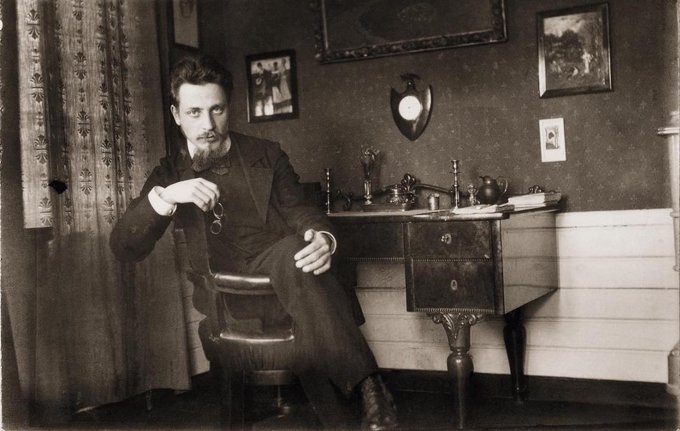
Everyone carries a room about inside him. This fact can even be proved by means of the sense of hearing. If someone walks fast and one pricks up one's ears and listens, say in the night, when everything round about is quiet, one hears, for instance, the rattling of a mirror not quite firmly fastened to the wall.
-
– Kafka
- Follow Notes from a Room on WordPress.com
Categories
Archives
- March 2026 (1)
- February 2026 (6)
- January 2026 (4)
- December 2025 (2)
- November 2025 (1)
- October 2025 (3)
- July 2025 (2)
- May 2025 (3)
- March 2025 (1)
- January 2025 (1)
- December 2024 (1)
- November 2024 (3)
- October 2024 (4)
- September 2024 (3)
- July 2024 (4)
- June 2024 (1)
- May 2024 (6)
- April 2024 (4)
- March 2024 (5)
- February 2024 (2)
- January 2024 (11)
- November 2023 (6)
- October 2023 (2)
- September 2023 (2)
- June 2023 (1)
- May 2023 (1)
- April 2023 (14)
- March 2023 (23)
- February 2023 (1)
- January 2023 (7)
- December 2022 (6)
- November 2022 (12)
- October 2022 (6)
- September 2022 (3)
- August 2022 (4)
- July 2022 (6)
- June 2022 (2)
- May 2022 (5)
- April 2022 (2)
- March 2022 (2)
- January 2022 (3)
- December 2021 (5)
- October 2021 (2)
- September 2021 (2)
- August 2021 (6)
- July 2021 (1)
- June 2021 (1)
- May 2021 (4)
- April 2021 (10)
- March 2021 (4)
- February 2021 (18)
- January 2021 (8)
- December 2020 (17)
- November 2020 (4)
- October 2020 (7)
- September 2020 (6)
- August 2020 (12)
- July 2020 (18)
- June 2020 (48)
- May 2020 (12)
- March 2020 (3)
- February 2020 (1)
- January 2020 (3)
- December 2019 (9)
- November 2019 (4)
- October 2019 (3)
- September 2019 (3)
- July 2019 (4)
- June 2019 (3)
- May 2019 (1)
- March 2019 (1)
- February 2019 (6)
- January 2019 (4)
- December 2018 (5)
- November 2018 (6)
- August 2018 (3)
- April 2018 (4)
- March 2017 (2)
- September 2016 (5)
- August 2016 (2)
- February 2016 (1)
- December 2015 (2)
- November 2015 (3)
- October 2015 (2)
- August 2015 (1)
- June 2015 (2)
- April 2015 (1)
- July 2014 (3)
- April 2014 (1)
- December 2013 (1)
- November 2013 (2)
- October 2013 (3)
- September 2013 (1)
- August 2013 (2)
- February 2013 (1)
- January 2013 (6)
- December 2012 (10)
- November 2012 (27)
- October 2012 (14)
- September 2012 (14)
- August 2012 (18)
- May 2012 (1)
- April 2012 (2)
- March 2012 (7)
- February 2012 (8)
- January 2012 (10)
- December 2011 (1)
- November 2011 (11)
- October 2011 (19)
- September 2011 (18)
- August 2011 (38)
- July 2011 (21)
- June 2011 (21)
- May 2011 (9)
- April 2011 (12)
- March 2011 (8)
- February 2011 (13)
- January 2011 (18)
- December 2010 (3)
- November 2010 (7)
- October 2010 (28)
- September 2010 (26)
- August 2010 (35)
- July 2010 (32)
- June 2010 (34)
- May 2010 (10)
- April 2010 (7)
- March 2010 (12)
- February 2010 (4)
- January 2010 (1)
- December 2009 (27)
- November 2009 (20)
- October 2009 (10)
- September 2009 (12)
- August 2009 (7)
- July 2009 (14)
- June 2009 (31)
- May 2009 (38)
- April 2009 (13)
- March 2009 (17)
- February 2009 (19)
- January 2009 (18)
- December 2008 (18)
- November 2008 (8)
- October 2008 (2)
- September 2008 (2)
- August 2008 (15)
- July 2008 (5)
- June 2008 (8)
- May 2008 (2)
- April 2008 (1)
- March 2008 (5)
- February 2008 (4)
- January 2008 (8)
- December 2007 (4)
- November 2007 (12)
- October 2007 (6)
- September 2007 (2)
- July 2007 (1)
Life becomes ideas and the ideas return to life.
Merleau-Ponty
Comments Off on
Posted in Merleau-Ponty
One reaches (or I do) these dumb places in life. I suppose there’s nothing for it but to go on living. Speech may come. Or it may not. And if it doesn’t I suppose one just has to be content to be dumb. At least not shout for the mere sake of making a noise.
Nan Shepherd
Comments Off on
Posted in Nan Shepherd
More and more, fundamental life and death decisions are being made by machines, by software, without human intervention … And behind these machines, far behind them, opaque monoliths of capital, vast and cold and unsympathetic.
Will Wiles, via here
Comments Off on
Posted in Writing
The everyday with its chores and routines was something I endured, not something I enjoyed, not something that gave me a sense of meaning or made me happy. It wasn’t a question of not wanting to wash the floor or change nappies, but of something more basic, namely that I didn’t experience the value of daily life but always longed to escape and always had. The life I lived wasn’t my own. I tried to make it mine, that was the struggle I was engaged in, because of course that was what I wanted, but I failed, the longing for something else completely hollowed out everything I did. What was the problem?
Knausgaard, My Struggle, vol 2 (my trans.)
Comments Off on
Posted in Knausgaard
Writing now means somehow prevailing over oneself, for what to write when everything one touches is unspeakable, unrecognizable, when nothing belongs to one, no feeling, no hope.
Rilke
Comments Off on
Posted in rilke
The One and the Many
Unlike in Classical Greece, Egyptian cosmological, metaphysical and ethical concepts did not crystallize over the course of a few centuries. Instead they were the outcome of millennia of intellectual labour, during which hundreds of priests developed and grappled with challenging, often contradictory, ways of making sense of the universe. As part of that process, several schools of religious thought emerged, occasionally competing to establish their respective deities as the supreme creator. This jostling inadvertently ignited several intellectual breakthroughs at the end of the second millennium BCE, which resulted in Egyptians advancing ideas remarkably similar to some of the mainstays of later Hellenic and Hellenistic thought.
In ‘Theological Responses to Amarna’ (2004), German Egyptological heavyweight Jan Assmann showed how the process began in the fourteenth century BCE when Akhenaten ascended to the throne. He sought to dismantle the powerful religious establishment that stood in the way of his quest for absolute power by using a proto-scientific worldview to eradicate Egypt’s polytheism. That is, he banned the entire Egyptian pantheon and replaced it with a single figure: Aten, the personification of the disc of the sun, or of solar energy. Anticipating the earliest pre-Socratic thinkers, who in various ways traced the source of the cosmos to a single element, Akhenaten promulgated that solar energy was not only divine, it was the sole element out of which the entire universe evolved. Each component of visible reality was described as an ‘evolution’ or emanation of that energy. In turn, the realm of invisible deities, the underworld, and spirits, were dismissed as fairy tales from a bygone era. Temples were closed, inscriptions referencing other gods were erased, and even representations of other deities were destroyed. This was the first time in history that a form of monotheism had been adopted as the official creed of a kingdom.
[…]
The priesthood answered Akhenaten’s monist challenge in a way that prefigured Hermetic, and perhaps even ancient Greek efforts, such as those of Parmenides and his followers, to uncover the oneness concealed behind the plurality of the visible world. The Egyptian priesthood revamped older ideas to posit a hidden divine entity, symbolized by the sun, as constituting and animating the universe. Struggling with the limited vocabulary of their time, priests tried alluding to this unknowable Supreme Being’s immaterial qualities by loosely naming it ‘One’, ‘hidden’, and ‘soul-like’. They claimed that it was inaccessible to language or intellect and inhabited a separate ontological space. Paradoxically, the same priests also averred that the millions of gods and other constituents of the universe were constantly evolving parts of this ineffable being, which remained present yet invisible in and as the cosmos. Egyptians occasionally used the word ‘Amun’ (‘the hidden’) as a pseudonym to refer to the nameless Supreme Being who was simultaneously a boundless unified hidden One and the infinite Many of the cosmos. This emphasis on the invisible and underlying ‘oneness’ of the visible universe may well have been a precursor to the Eleatic Greek idea that the manifold world of sense perception conceals or misrepresents true reality, which is singular, all-encompassing, omnipresent Being.
– Peter Flegel, ‘Does Western Philosophy have Egyptian Roots?’
Comments Off on The One and the Many
Posted in Egyptian cosmology
Physical work
Physical work is a specific contact with the beauty of the world, and can even be, in its best moments, a contact so full that no equivalent can be found elsewhere. The artist, the scholar, the philosopher, the contemplative should really admire the world and pierce through the film of unreality that veils it and makes of it, for nearly all men at nearly every moment of their lives, a dream or stage set. They ought to do this but more often than not they cannot manage it. He who is aching in every limb, worn out by the effort of a day of work, that is to say a day when he has been subject to matter, bears the reality of the universe in his flesh like a thorn. The difficulty for him is to look and to love. If he succeeds, he loves the Real.
That is the immense privilege God has reserved for his poor. But they scarcely ever know it. No one tells them. Excessive fatigue, harassing money worries, and the lack of true culture prevent them from noticing it. A slight change in these conditions would be enough to open the door to a treasure. It is heart-rending to see how easy it would be in many cases for men to procure a treasure for their fellows and how they allow centuries to pass without taking the trouble to do so.
At the time when there was a people’s civilisation, of which we are today collecting the crumbs as museum pieces under the name of folklore, the people doubtless had access to the treasure. Mythology too, which is very closely related to folklore, testifies to it, if we can decipher the poetry it contains.
– Simone Weil, ‘Forms of the Implicit Love of God’ (tr. Craufurd)
Comments Off on Physical work
Posted in Simone Weil, Writing
The central event
We’ve come to the end of the day: let us say that in the course of that day something important has happened, something significant, the sort of thing that could be the inspiration for a film, that has the makings of a conflict of ideas that could become a picture. But how did this day imprint itself on our memory? As something amorphous, vague, with no skeleton or schema. Like a cloud. And only the central event of that day has become concentrated, like a detailed report, lucid in meaning and clearly defined. Against the background of the rest of the day, that event stands out like a tree in the mist […] Isolated impressions of the day have set off impulses within us, evoked associations; objects and circumstances have stayed in our memory, but with no sharply defined contours, incomplete, apparently fortuitous. Can these impressions of life be conveyed through film? They undoubtedly can; indeed it is the special virtue of cinema, as the most realistic of the arts, to be the means of such communication.
– Tarkovsky, Sculpting in Time (tr. Hunter-Blair), via here
Comments Off on The central event
Posted in Tarkovsky
 Notes from a Room